Perfect Rosemary Sourdough Focaccia: Easy Holiday Favorite
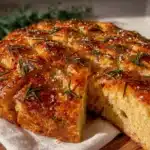
This Perfect Rosemary Sourdough Focaccia is a showstopper bread made with a sourdough starter, featuring a crispy bottom, golden blistered top, and an airy, chewy crumb with a subtle tang. It’s surprisingly simple to make and perfect for holiday hosting.
- Prep Time: 20 minutes
- Cook Time: 25-30 minutes
- Total Time: 12-24 hours (includes fermentation and proofing)
- Yield: 12 servings 1x
- Category: Bread
- Cuisine: Italian
Ingredients
- 500g (about 4 cups) bread flour
- 200g (about 1 cup) active sourdough starter, bubbly and fed within 8-12 hours
- 375g (about 1 ½ cups) warm water, around 80°F (27°C)
- 60g (about ¼ cup) extra-virgin olive oil, plus 2-3 tablespoons for pan and topping
- 10g (about 2 teaspoons) fine sea salt
- 2–3 tablespoons fresh rosemary, finely chopped
- Flaky sea salt (e.g., Maldon) for finishing
Instructions
- Mix the dough: In a large mixing bowl, combine the bread flour and fine sea salt. In a separate bowl or measuring cup, whisk together the warm water, active sourdough starter, and 60g of olive oil until the starter is mostly dissolved. Pour the wet ingredients into the dry ingredients and mix with a spatula or your hand until no dry flour remains. The dough will be very sticky and shaggy. Cover the bowl with plastic wrap and let it rest for 30 minutes.
- Perform stretch and folds: After the rest, wet your hand slightly. Grab one side of the dough, stretch it up as far as it will go without tearing, and fold it over the top. Rotate the bowl a quarter turn and repeat. Do this 4 times total (one full rotation). Cover and rest for 30 minutes. Repeat this stretch and fold process 3 more times, for a total of 4 sets over 2 hours.
- Bulk fermentation: After the stretch and folds, cover the bowl tightly and let it sit at room temperature until the dough has nearly doubled in size and is bubbly on top (about 8-12 hours at 70°F/21°C). For best flavor, refrigerate the dough for 12-24 hours after the stretch and folds.
- Prepare the pan: Generously coat a 9×13-inch baking pan with 2 tablespoons of olive oil, making sure the bottom and sides are well coated.
- Transfer and stretch the dough: Gently scrape the dough out of the bowl into the oiled pan. Let it rest for 10 minutes. Using oiled fingertips, gently stretch and press the dough to fill the pan. If it resists, let it rest another 10 minutes and try again.
- Final proof: Cover the pan with plastic wrap or a damp towel and let the dough proof at room temperature until puffy and risen to about 1 inch thick (2-3 hours).
- Dimple and top: About 20 minutes before baking, preheat your oven to 425°F (220°C). Uncover the proofed dough. Drizzle with another tablespoon of olive oil. Using oiled fingertips, press deep dimples all over the surface of the dough, right down to the bottom of the pan. Sprinkle the chopped fresh rosemary evenly over the top, followed by a generous pinch of flaky sea salt.
- Bake: Place the pan in the preheated oven and bake until deep golden brown on top and sounds hollow when tapped on the bottom (25-30 minutes). If the top is browning too quickly, tent loosely with foil for the last 5-10 minutes.
- Cool: Let the focaccia cool in the pan for 5 minutes, then carefully transfer it to a wire rack. Cool for at least 20 minutes before slicing.
Notes
For extra crunch, preheat the metal pan with oil in the oven while it preheats. Don’t skip the stretch and folds—they build gluten for an airy crumb. Use room temperature water (about 80°F/27°C). Be generous with olive oil for a crispy bottom and golden crust. Let the dough proof until truly puffy and jiggly. Press dimples all the way to the bottom of the pan. Cool on a wire rack to keep the bottom crispy. Store leftovers in an airtight container at room temperature for up to 3 days, or freeze for up to 3 months. Reheat in a 350°F (175°C) oven for 5-10 minutes.
Nutrition
- Serving Size: 1 square
- Calories: 220
- Sodium: 380
- Fat: 8
- Saturated Fat: 1
- Carbohydrates: 32
- Fiber: 1
- Protein: 5
Keywords: sourdough focaccia, rosemary focaccia, holiday bread, sourdough bread, easy focaccia, no yeast bread