This was supposed to be a pot of black bean soup. I had the ham hock soaking, the onions diced, the garlic ready to go. But somewhere between the pantry and the counter, I grabbed the wrong bag. It happens, you know? I was already running late for a New Year’s Eve gathering at my friend Maria’s place, and I was feeling that familiar pressure of wanting to bring something good. I dumped the contents into the slow cooker without a second thought. It wasn’t until the beans had been simmering for about an hour that I noticed the pale, almost creamy color of the beans instead of the deep black I was expecting. My heart sank. I honestly thought I had ruined the whole thing.
But let me tell you something funny about mistakes. Sometimes they turn out better than the plan. By the time I got to Maria’s, that slow cooker was full of the most tender, flavorful beans I had ever made. The ham had melted into the broth, the garlic had softened into something sweet, and the whole thing had this rich, almost buttery texture that black beans just don’t have. Everyone kept asking for the recipe, and I had to admit I didn’t even know what kind of beans I had used. I had to dig the bag out of the trash to check. Black-eyed peas. Of all things.
Now, I know black-eyed peas are supposed to be lucky for New Year’s. But honestly, that first batch felt like more than luck. It felt like the universe telling me to stop overthinking things in the kitchen. Since then, this cozy slow cooker black-eyed peas recipe has become my official New Year’s tradition. It’s the dish I bring when I want to show up with something that feels like a hug in a bowl. And maybe you’ve been there too—standing in your kitchen, wondering if you’ve just made a terrible mistake. Trust me, sometimes the best recipes come from those moments.
Why You’ll Love This Recipe
Let me be straight with you. I’ve tested this recipe at least a dozen times over the past few years, tweaking the seasonings, adjusting the cooking time, and even swapping out the meat a few times. What I’ve landed on is the version that works every single time. Here’s why this one is different from every other black-eyed peas recipe you’ll find online:
- Truly Hands-Off: The slow cooker does all the heavy lifting. You toss everything in, set it, and forget it. No soaking required. No stirring. No standing over the stove. This is the kind of recipe that lets you enjoy your New Year’s Eve party without hiding in the kitchen.
- Simple Pantry Ingredients: You probably have most of these in your kitchen right now. The only thing you might need to grab is a bag of dried black-eyed peas and maybe a ham hock or some bacon. No fancy grocery store runs required.
- Perfect for New Year’s Traditions: Black-eyed peas are the classic Southern good luck food for New Year’s Day. But this recipe is also great for any cold winter gathering, potluck, or cozy family dinner. It fits the season perfectly.
- Crowd-Pleasing Comfort: I have served this to picky kids, skeptical in-laws, and die-hard meat-and-potatoes types. Every single person has gone back for seconds. The broth is rich and savory, the peas are tender but not mushy, and the whole thing just feels like home.
- Unbelievably Delicious: The texture is what gets me every time. The peas hold their shape but melt in your mouth. The broth thickens up naturally from the peas breaking down slightly, creating this silky, almost gravy-like consistency that you just want to soak up with cornbread.
What makes this recipe stand out is the balance of flavors. I use a smoked ham hock for that deep, porky richness, but I also add a splash of apple cider vinegar at the end to brighten everything up. It’s that little trick that keeps the dish from feeling heavy. Plus, the garlic and onion cook down so slowly that they become almost sweet, creating a flavor base that you just can’t get from canned beans.
This isn’t just another bean recipe. This is the one that makes you close your eyes after the first bite. It’s comfort food at its finest—simple, honest, and deeply satisfying. And honestly, it’s the kind of dish that makes you feel like you’ve got the whole year ahead of you, full of good things.
What Ingredients You Will Need
This recipe uses simple, wholesome ingredients to deliver bold flavor and satisfying texture without the fuss. Most of these are pantry staples or easy to find at any grocery store. Here is what you will need:
For the Black-Eyed Peas
- 1 pound dried black-eyed peas (about 2 cups) – No need to soak them overnight. Just give them a good rinse and pick out any shriveled ones or small pebbles. I prefer the generic store brand for this, honestly—they cook up just as well as the fancy ones.
- 1 large yellow onion, diced – About 1 ½ cups. The onion melts into the broth as it cooks, adding sweetness and depth. You can use white or sweet onion if that is what you have.
- 4 cloves garlic, minced – Fresh garlic is best here. The pre-minced stuff in a jar just does not have the same punch. I use about 4 medium cloves, but if you love garlic like I do, feel free to add an extra one.
- 1 smoked ham hock (about 12 ounces) – This is the secret to the rich, smoky flavor. You can find ham hocks in the meat section near the pork. If you cannot find one, use 6 slices of thick-cut bacon or 1 cup of diced ham. I have used all three options, and the ham hock gives the best broth.
- 4 cups low-sodium chicken broth – Using low-sodium broth lets you control the salt level. The ham hock adds plenty of salt on its own, so you do not want to overdo it. You can also use vegetable broth if you want to keep it meat-free, but you will lose some of that smoky depth.
- 2 cups water – Just enough liquid to keep everything covered. The peas will absorb a lot as they cook, so do not be tempted to skimp on the liquid.
- 1 teaspoon smoked paprika – This adds a subtle smokiness that complements the ham hock perfectly. I recommend the Spanish smoked paprika from Penzeys if you can get it—it has a deep, almost woodsy flavor.
- 1 teaspoon dried thyme – Thyme and beans are a classic pairing. It adds an earthy, slightly floral note that brightens up the dish.
- ½ teaspoon black pepper – Freshly ground is always better. Do not use pre-ground pepper here—it just does not have the same kick.
- 1 bay leaf – This adds a subtle layer of flavor that you will not even notice until it is missing. Remember to fish it out before serving.
- 2 tablespoons apple cider vinegar – Added at the end. This is the magic ingredient that balances all the richness and wakes up the flavors. Do not skip it.
- Salt to taste – Wait until the end to add salt. The ham hock and broth both contain salt, and you do not want to oversalt before the liquid reduces.
For Serving (Optional but Recommended)
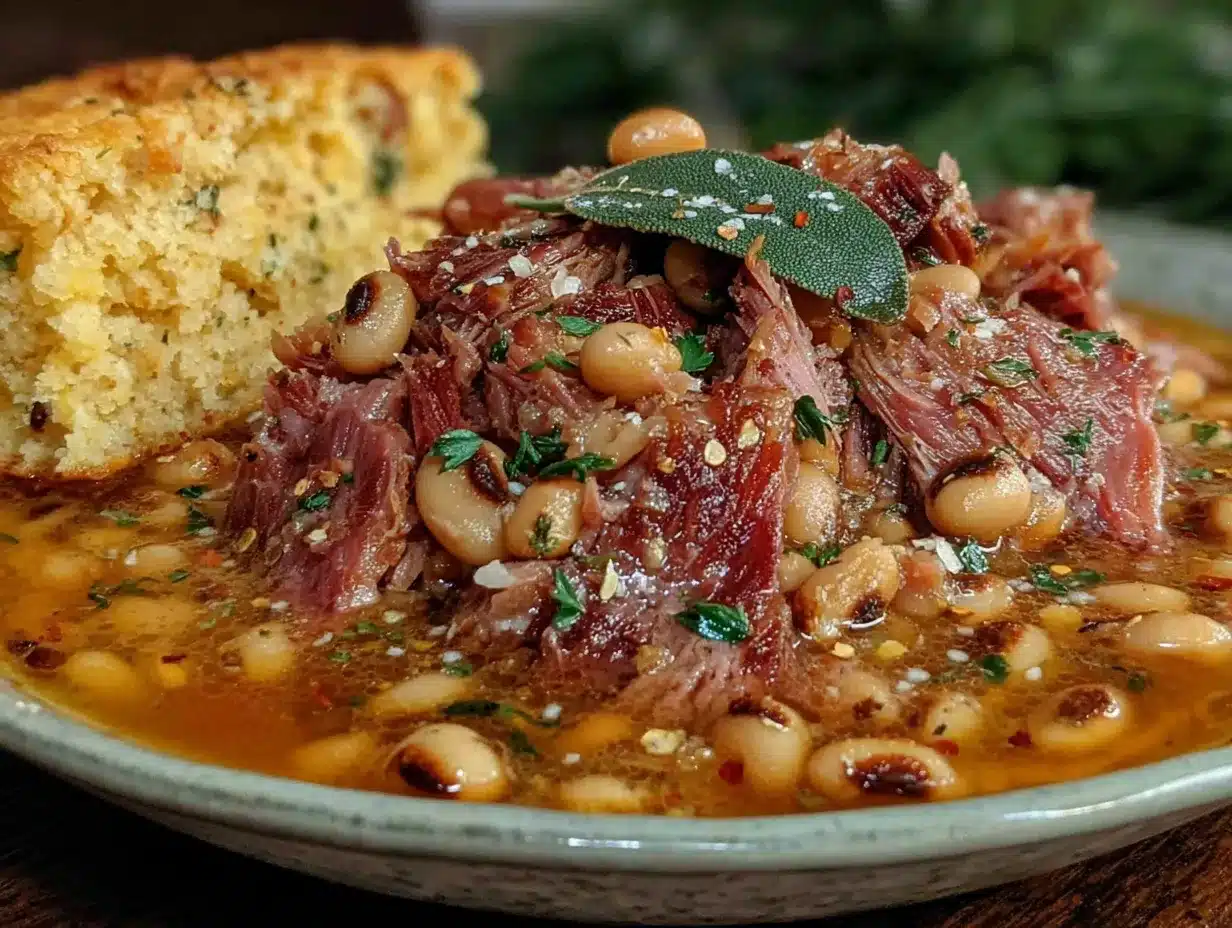
- Cooked white rice or cornbread – The peas are delicious on their own, but serving them over rice or with a wedge of cornbread makes it a complete meal. I am partial to buttermilk cornbread myself.
- Fresh parsley or green onions, chopped – A sprinkle of fresh herbs on top adds color and a pop of freshness. It makes the dish look as good as it tastes.
- Hot sauce – Some people like a kick. I keep a bottle of Tabasco on the table for anyone who wants to spice things up.
Equipment Needed
You do not need a lot of fancy equipment for this recipe. Here is what you will need:
- 6-quart or larger slow cooker – This is the star of the show. I use a Cuisinart 6-quart model that I have had for years. It is big enough to hold all the ingredients with room to spare. If your slow cooker is smaller, you can halve the recipe or cook it in a Dutch oven on the stovetop instead.
- Cutting board and sharp knife – For dicing the onion and mincing the garlic. A dull knife makes this job miserable. Trust me, I learned that the hard way.
- Measuring cups and spoons – For the broth, spices, and vinegar. I like using a set of stainless steel measuring cups—they last forever.
- Wooden spoon or spatula – For stirring everything together before cooking. You will not need to stir during cooking, so do not worry about that.
- Colander – For rinsing the dried black-eyed peas. A fine-mesh colander works best so the small peas do not fall through.
- Tongs – For removing the ham hock at the end. The meat will be falling off the bone, so tongs make it easier to handle.
- Small bowl – For shredding the ham hock meat. You will pull the meat off the bone and stir it back into the peas.
If you do not have a slow cooker, you can absolutely make this on the stovetop. Use a heavy-bottomed Dutch oven or large pot. Bring everything to a boil, then reduce the heat to low, cover, and simmer for about 2 to 3 hours, or until the peas are tender. You will need to check the liquid level occasionally and add more water if needed. But honestly, the slow cooker method is so much easier and more forgiving.
Preparation Method
Making this cozy slow cooker black-eyed peas recipe is almost embarrassingly easy. Here is how to do it, step by step:
- Rinse and sort the black-eyed peas (2 minutes). Place the dried peas in a colander and rinse them under cold running water. As you rinse, pick through them and discard any that are shriveled, discolored, or look like small rocks. I have found a few pebbles in bags before, so do not skip this step. It takes almost no time and saves you from a broken tooth.
- Dice the onion and mince the garlic (5 minutes). Peel the onion and cut it into small dice. You want pieces about ½ inch so they soften evenly. For the garlic, smash each clove with the flat side of your knife, then chop it finely. If you are in a hurry, you can use a garlic press, but I find that hand-mincing gives a better texture.
- Combine everything in the slow cooker (3 minutes). Place the rinsed black-eyed peas, diced onion, minced garlic, smoked ham hock, chicken broth, water, smoked paprika, dried thyme, black pepper, and bay leaf into the slow cooker. Give everything a good stir with a wooden spoon to distribute the spices. The ham hock will be sitting on top, and that is fine—it will release its flavor as it cooks.
- Set the slow cooker and walk away (5 seconds). Cover the slow cooker with the lid and set it to LOW for 8 hours or HIGH for 4 to 5 hours. I prefer the low and slow method because the peas cook more evenly and the broth develops deeper flavor. If you are short on time, the high setting works, but the texture will not be quite as creamy.
- Check for doneness (1 minute). After the cooking time is up, remove the lid and test a few black-eyed peas. They should be tender but still hold their shape. If you bite into one and it feels gritty or hard, they need more time. Cover and cook for another 30 minutes to 1 hour on low. The cooking time can vary depending on how old your dried peas are, so do not panic if they need a little longer.
- Remove the ham hock and shred the meat (5 minutes). Using tongs, carefully lift the ham hock out of the slow cooker and place it on a cutting board or in a small bowl. Let it cool for a minute or two until you can handle it. Then, using two forks, pull the meat off the bone. Discard the bone, any large pieces of fat, and the skin. Shred the meat into small pieces and return it to the slow cooker.
- Add the apple cider vinegar and season with salt (1 minute). Stir in the apple cider vinegar. Taste the broth and add salt as needed. I usually start with ½ teaspoon and go from there. Remember that the ham hock and broth already have salt, so go slowly. You can always add more, but you cannot take it out.
- Remove the bay leaf and serve (30 seconds). Fish out the bay leaf and discard it. Ladle the black-eyed peas into bowls and serve hot. If you are serving over rice, spoon the peas over a bed of cooked rice. Top with chopped parsley or green onions if you like.
A few notes as you cook: The broth will look thin at first, but it will thicken as the peas release their starch. Do not be tempted to add more liquid unless the peas are not covered at the start. Also, if you want a thicker, almost stew-like consistency, you can mash about ½ cup of the peas against the side of the slow cooker with a fork before serving. This releases more starch and makes the broth creamier. I do this about half the time, depending on my mood.
Cooking Tips & Techniques
Over the years, I have made every mistake you can imagine with this recipe. I have oversalted it, undercooked it, and even burned the bottom of the slow cooker once because I did not add enough liquid. Here is what I have learned so you do not have to make the same mistakes:
Do not skip the vinegar. I know it seems like a small thing, but the apple cider vinegar at the end is what makes this dish sing. It cuts through the richness of the ham hock and brightens up all the other flavors. Without it, the peas taste flat and one-dimensional. I once forgot to add it, and the whole batch felt like something was missing. My husband could not put his finger on it, but he knew it was not as good as usual.
Watch your salt levels. This is the most common mistake I see people make with slow cooker beans. The ham hock and broth both contain salt, and as the liquid reduces, the salt concentration increases. If you salt at the beginning, you will end up with a dish that is way too salty by the end. Always wait until the very last step to add salt. And when you do, taste first. You might not need any at all.
Do not peek. I know it is tempting to lift the lid and check on things, but every time you open the slow cooker, you release heat and extend the cooking time. Trust the process. If you are using the low setting, just let it do its thing for the full 8 hours. If you are worried about the liquid level, you can check once after about 6 hours, but try to resist the urge.
Timing is flexible. One of the best things about this recipe is that it is forgiving. If you cook it for 9 hours instead of 8, it will still be delicious. If you cook it for 7, it might need a little more time. The peas will let you know when they are done. Just taste one. If it is tender, it is ready. If it is still firm, give it more time. No stress.
Make it ahead. This is one of those recipes that actually tastes better the next day. The flavors have time to meld and deepen overnight. I often make this the day before New Year’s Eve and then reheat it in the slow cooker on the day. It saves me so much stress on a busy holiday.
Variations & Adaptations
One of the things I love about this recipe is how easy it is to adapt. Here are some variations I have tried and loved:
Vegetarian Version: Omit the ham hock and use vegetable broth instead of chicken broth. To get that smoky flavor back, add 1 teaspoon of liquid smoke and 1 tablespoon of smoked paprika. You can also add a diced carrot and a stalk of celery for extra depth. I made this version for my vegetarian sister-in-law last year, and she said it was the best black-eyed peas she had ever had. High praise.
Spicy Kick: If you like heat, add 1 diced jalapeño (seeds and all) along with the onion and garlic. You can also stir in 1 teaspoon of cayenne pepper or a chopped chipotle pepper in adobo sauce. The smoky heat pairs beautifully with the ham hock. I do this when I am serving a crowd that likes things spicy.
Greens Addition: For a true Southern New Year’s meal, stir in a handful of chopped collard greens or kale during the last 30 minutes of cooking. The greens wilt down into the broth and add a nice bitterness that balances the richness of the peas. Plus, greens are also considered lucky for the new year, so you get double the good fortune.
Herb Swap: If you do not have dried thyme, you can use 1 tablespoon of fresh thyme or 1 teaspoon of dried oregano. I have also used a sprig of fresh rosemary, which adds a lovely piney aroma. Just remember to remove the rosemary sprig before serving, along with the bay leaf.
Instant Pot Adaptation: If you want to make this faster, you can use an Instant Pot or other electric pressure cooker. Sauté the onion and garlic in the pot first, then add the remaining ingredients. Cook on high pressure for 35 minutes, then let the pressure release naturally for 15 minutes. The texture is slightly different—a bit firmer—but it is still delicious and ready in under an hour.
Serving & Storage Suggestions
These cozy slow cooker black-eyed peas are incredibly versatile when it comes to serving. Here is how I like to enjoy them:
Serving Temperature and Presentation: Serve the peas hot, straight from the slow cooker. Ladle them into wide, shallow bowls so the broth pools nicely. If you are serving over rice, place a scoop of rice in the center of the bowl and spoon the peas around it. Top with a sprinkle of fresh parsley or chopped green onions for color. A wedge of buttermilk cornbread on the side is practically mandatory in my house.
Complementary Dishes: These peas pair beautifully with collard greens, cornbread, or a simple side salad. For a heartier meal, serve them alongside roasted chicken or pulled pork. They also work great as a side dish for a New Year’s Day brunch or lunch spread. I have even served them as a topping for baked potatoes, and it was a hit.
Storage Instructions: Leftovers keep well in the refrigerator for up to 5 days. Store them in an airtight container. The flavors actually improve over the first day or two as the seasonings meld. The peas will also absorb more liquid as they sit, so the leftovers will be thicker than the original batch. That is fine—just add a splash of water or broth when reheating if you want to thin them out.
Freezer Instructions: This recipe freezes beautifully. Let the peas cool completely, then transfer them to freezer-safe containers or zip-top bags. They will keep for up to 3 months. To thaw, place the container in the refrigerator overnight, then reheat on the stovetop or in the microwave. I often double the recipe and freeze half for a quick meal later in the winter.
Reheating Methods: The best way to reheat these peas is on the stovetop over medium-low heat. Add a splash of water or broth to loosen them up, and stir occasionally until heated through. You can also reheat them in the microwave in 30-second bursts, stirring in between. If the peas seem dry, add a little liquid before reheating.
Flavor Development: As I mentioned, these peas taste even better the next day. The smoky, savory flavors deepen and become more complex. If you can, make them a day ahead and let them sit in the refrigerator overnight. When you reheat them, they will taste like you spent hours perfecting them—even though you barely lifted a finger.
Nutritional Information & Benefits
Black-eyed peas are not just delicious—they are also packed with nutrition. Here is a rough estimate of what you are getting in a serving (about 1 cup of peas with broth, without rice):
- Calories: Approximately 220-250
- Protein: 14-16 grams
- Fiber: 8-10 grams
- Fat: 4-6 grams (mostly from the ham hock)
- Carbohydrates: 35-40 grams
- Iron: 20% of the Daily Value
- Folate: 30% of the Daily Value
- Potassium: 15% of the Daily Value
Health Benefits: Black-eyed peas are a fantastic source of plant-based protein and fiber, which helps keep you full and supports healthy digestion. They are also rich in folate, which is important for cell growth and function, and iron, which helps carry oxygen through your blood. The fiber content also helps regulate blood sugar levels, making this a great option for anyone watching their glucose.
Dietary Considerations: This recipe is naturally gluten-free and dairy-free. If you make the vegetarian version, it is also suitable for vegans. The ham hock version contains pork, so it is not suitable for those avoiding meat. If you are watching your sodium, use low-sodium broth and go easy on the added salt. The ham hock does add a fair amount of sodium, so be mindful of that.
Potential Allergens: The main allergens to note are pork (if using the ham hock) and possibly gluten if you are serving it with cornbread that contains wheat flour. Otherwise, this recipe is free of the top allergens like nuts, dairy, eggs, and shellfish.
My Personal Perspective: I love that this recipe feels indulgent but is actually pretty healthy. It is the kind of comfort food that nourishes you from the inside out. On New Year’s Day, when everyone is tired and maybe a little hungover, a bowl of these peas with some cornbread is exactly what the body needs. It is warm, filling, and full of good things to start the year off right.
Conclusion
So there you have it. A recipe that started as a complete accident and ended up becoming one of my most treasured traditions. These cozy slow cooker black-eyed peas are proof that you do not need to be a perfect cook to make something incredible. You just need to be willing to grab the wrong bag of beans every now and then.
I hope you give this recipe a try, whether it is for New Year’s Day or just a cold winter evening when you need something warm and comforting. Feel free to make it your own—add more spice, throw in some greens, or swap the ham hock for bacon. The beauty of this dish is that it is forgiving and flexible, just like the best recipes always are.
If you make it, I would love to hear how it turned out. Drop a comment below and let me know if you made any changes or if it became a new tradition in your house. And if you have a recipe disaster story of your own, share that too. Honestly, those are my favorite kinds of stories to read. Happy New Year, and happy cooking. May your year be full of happy accidents that turn into something wonderful.
Frequently Asked Questions
Do I really need to soak the black-eyed peas overnight?
Nope. That is one of the best things about this recipe. You can use dried black-eyed peas straight from the bag without any soaking. The slow cooker does all the work for you. Just rinse them and pick out any debris, and you are good to go.
Can I use canned black-eyed peas instead of dried?
You can, but the texture and flavor will be different. Canned peas are already cooked, so they will break down more quickly and the broth will not be as rich. If you are in a hurry, drain and rinse two 15-ounce cans, reduce the cooking time to 2-3 hours on low, and reduce the liquid to 2 cups of broth. But honestly, the dried version is so much better.
How do I know when the black-eyed peas are done?
The best way is to taste one. It should be tender but still hold its shape. If it feels gritty or hard in the center, it needs more time. You can also press a pea between your fingers—if it smushes easily, it is done. The cooking time can vary depending on how old the dried peas are, so do not rely solely on the timer.
Can I make this recipe in a Dutch oven instead of a slow cooker?
Absolutely. Use a heavy-bottomed Dutch oven or large pot. Sauté the onion and garlic in a little oil first, then add the remaining ingredients. Bring to a boil, reduce the heat to low, cover, and simmer for 2 to 3 hours, or until the peas are tender. Check the liquid level occasionally and add more water if needed. The stovetop version is a bit more hands-on, but it works great.
What can I use instead of a ham hock?
If you cannot find a ham hock, you have several options. Use 6 slices of thick-cut bacon, cooked and crumbled, or 1 cup of diced cooked ham. For a vegetarian version, skip the meat entirely and add 1 teaspoon of liquid smoke and an extra teaspoon of smoked paprika. Each option gives a slightly different flavor, but all are delicious in their own way.
Pin This Recipe!
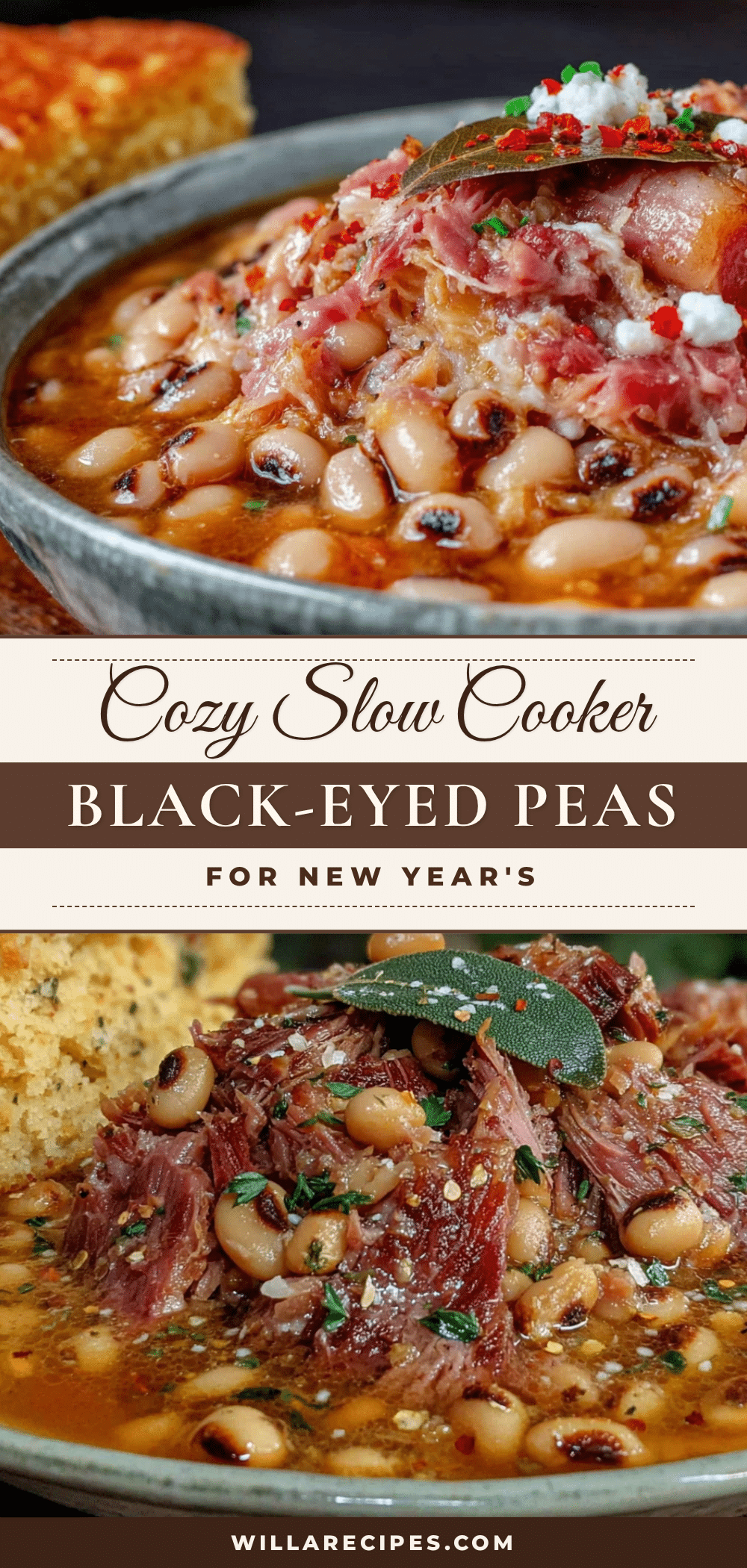
Best Easy Slow Cooker Black-Eyed Peas for New Year’s

A cozy, hands-off slow cooker recipe for tender black-eyed peas with smoky ham hock, perfect for New Year’s traditions or any cold winter gathering. This forgiving dish turns a happy accident into a beloved comfort food classic.
- Prep Time: 10 minutes
- Cook Time: 8 hours (low) or 4-5 hours (high)
- Total Time: 8 hours 10 minutes (low) or 4 hours 15 minutes (high)
- Yield: 8 servings 1x
- Category: Main Course
- Cuisine: Southern
Ingredients
- 1 pound dried black-eyed peas (about 2 cups)
- 1 large yellow onion, diced (about 1 ½ cups)
- 4 cloves garlic, minced
- 1 smoked ham hock (about 12 ounces)
- 4 cups low-sodium chicken broth
- 2 cups water
- 1 teaspoon smoked paprika
- 1 teaspoon dried thyme
- ½ teaspoon black pepper, freshly ground
- 1 bay leaf
- 2 tablespoons apple cider vinegar
- Salt to taste
- Cooked white rice or cornbread (for serving, optional)
- Fresh parsley or green onions, chopped (for garnish, optional)
- Hot sauce (for serving, optional)
Instructions
- Rinse and sort the black-eyed peas: Place the dried peas in a colander and rinse under cold water. Pick out any shriveled peas or small pebbles.
- Dice the onion and mince the garlic.
- Combine everything in the slow cooker: Place the rinsed peas, diced onion, minced garlic, ham hock, chicken broth, water, smoked paprika, dried thyme, black pepper, and bay leaf into the slow cooker. Stir to distribute the spices.
- Cover and cook on LOW for 8 hours or on HIGH for 4 to 5 hours.
- Check for doneness: The peas should be tender but still hold their shape. If not, cook for another 30 minutes to 1 hour on low.
- Remove the ham hock and shred the meat: Using tongs, lift out the ham hock. Let cool slightly, then pull the meat off the bone with two forks. Discard bone, fat, and skin. Return the shredded meat to the slow cooker.
- Add the apple cider vinegar and season with salt: Stir in the vinegar. Taste and add salt as needed (start with ½ teaspoon).
- Remove the bay leaf and serve: Ladle into bowls. Serve hot, optionally over rice or with cornbread, and garnish with parsley or green onions.
Notes
Do not skip the apple cider vinegar—it brightens the flavors. Wait until the end to add salt, as the ham hock and broth already contain salt. The peas taste even better the next day. For a vegetarian version, omit the ham hock, use vegetable broth, and add 1 teaspoon liquid smoke and 1 tablespoon smoked paprika.
Nutrition
- Serving Size: 1 cup (without rice)
- Calories: 235
- Sugar: 4
- Sodium: 480
- Fat: 5
- Saturated Fat: 1.5
- Carbohydrates: 38
- Fiber: 9
- Protein: 15
Keywords: slow cooker black-eyed peas, New Year's recipe, black-eyed peas, ham hock, comfort food, Southern recipe, easy slow cooker