Mark wasn’t trying to impress anyone. I’d stopped by his place to pick up a chainsaw I was borrowing, and the smell hit me before I even got past the front porch. It was rich, smoky, and sweet—like someone had set up a camp stove inside a candy shop. I followed my nose to the back deck, where he was hunched over an old, dented smoker that looked like it had survived a war.
“What is that?” I asked, practically drooling.
He shrugged, not even looking up. “Just some deer jerky. Got the meat from a buddy who had too much from last season.”
Just some deer jerky. He said it like it was no big deal. Like he hadn’t just created the most incredible smell I’d ever encountered on a random Tuesday afternoon. He handed me a piece straight off the rack—warm, a little sticky from the brown sugar, with that sharp bite of black pepper hitting the back of my throat. I closed my eyes, and honestly, I think I made a sound that was a little embarrassing.
I pestered him for the recipe for weeks. He finally texted it to me, all in one run-on sentence with no measurements—just “brown sugar, pepper, smoke it low.” It took me four tries to get it right, and let me tell you, I burned through a lot of venison that fall. But this version right here? This is the one. It’s the one that finally made Mark nod and say, “Yeah, that’s it.”
Maybe you’ve been there—staring at a freezer full of deer meat, wondering what to do with it all. Or maybe you’ve never made jerky before and you’re just looking for a snack that doesn’t cost a fortune at the gas station. Either way, you’re in the right place. This budget-friendly smoked deer jerky with brown sugar and black pepper is the kind of recipe that makes you feel like you know a secret nobody else does.
Why You’ll Love This Recipe
Let me be real with you. I’ve tested a lot of jerky recipes over the years, and most of them fall into one of two traps: they’re either complicated enough to require a chemistry degree, or they taste like plain old salted shoe leather. This one is neither.
- Budget-Friendly: This recipe uses affordable cuts of venison and pantry staples you already have. No fancy ingredients, no specialty stores. I’m talking brown sugar, black pepper, soy sauce, and a few other basics. You can make a huge batch for what you’d spend on one small bag at the store.
- Simple Ingredients: You probably have most of this stuff in your kitchen right now. The marinade comes together in five minutes flat, and the hardest part is just waiting for the smoker to do its thing.
- Perfect for Busy Families: This jerky is a lifesaver for lunches, road trips, after-school snacks, and hunting season. It keeps for weeks, and my kids fight over the last pieces. It’s protein-packed and filling, so it actually keeps everyone full between meals.
- Crowd-Pleaser: I’ve brought this to football games, camping trips, and family gatherings, and it disappears every single time. Even people who swear they don’t like venison end up asking for the recipe.
- Unbelievably Delicious: The combination of sweet brown sugar and bold black pepper is a classic for a reason. The smoke adds this deep, rich flavor that you just can’t get from an oven or dehydrator. It’s chewy, not hard, with just the right amount of snap when you bite into it.
This recipe isn’t just good—it’s the kind that makes you close your eyes after the first bite. It’s comfort food reimagined as a portable snack. Perfect for impressing your hunting buddies without any stress, or turning a freezer full of deer meat into something you actually look forward to eating.
What Ingredients You Will Need
This recipe uses simple, wholesome ingredients to deliver bold flavor and satisfying texture without the fuss. Most of these are pantry staples, and the ones that aren’t are easy to find at any grocery store.
For the Marinade
- 2 pounds venison roast or steak (trimmed of all silver skin and excess fat—fat goes rancid in jerky)
- 1/2 cup low-sodium soy sauce (I prefer Kikkoman or San-J for consistent flavor; use tamari for gluten-free)
- 1/4 cup Worcestershire sauce (Lea & Perrins is my go-to; adds that umami depth)
- 1/4 cup packed brown sugar (light or dark both work; dark gives a deeper molasses flavor)
- 2 tablespoons coarsely ground black pepper (freshly ground is best, but pre-ground works in a pinch)
- 1 tablespoon kosher salt (Diamond Crystal or Morton; reduce to 2 teaspoons if using table salt)
- 1 teaspoon garlic powder (not garlic salt; we’re controlling the salt ourselves)
- 1 teaspoon onion powder (adds a subtle savory note that balances the sweet)
- 1/2 teaspoon curing salt (Prague Powder #1) (optional but recommended for food safety and color; skip if you plan to freeze or eat within a week)
- 1/4 cup cold water (helps thin the marinade and distribute flavors evenly)
Ingredient Tips
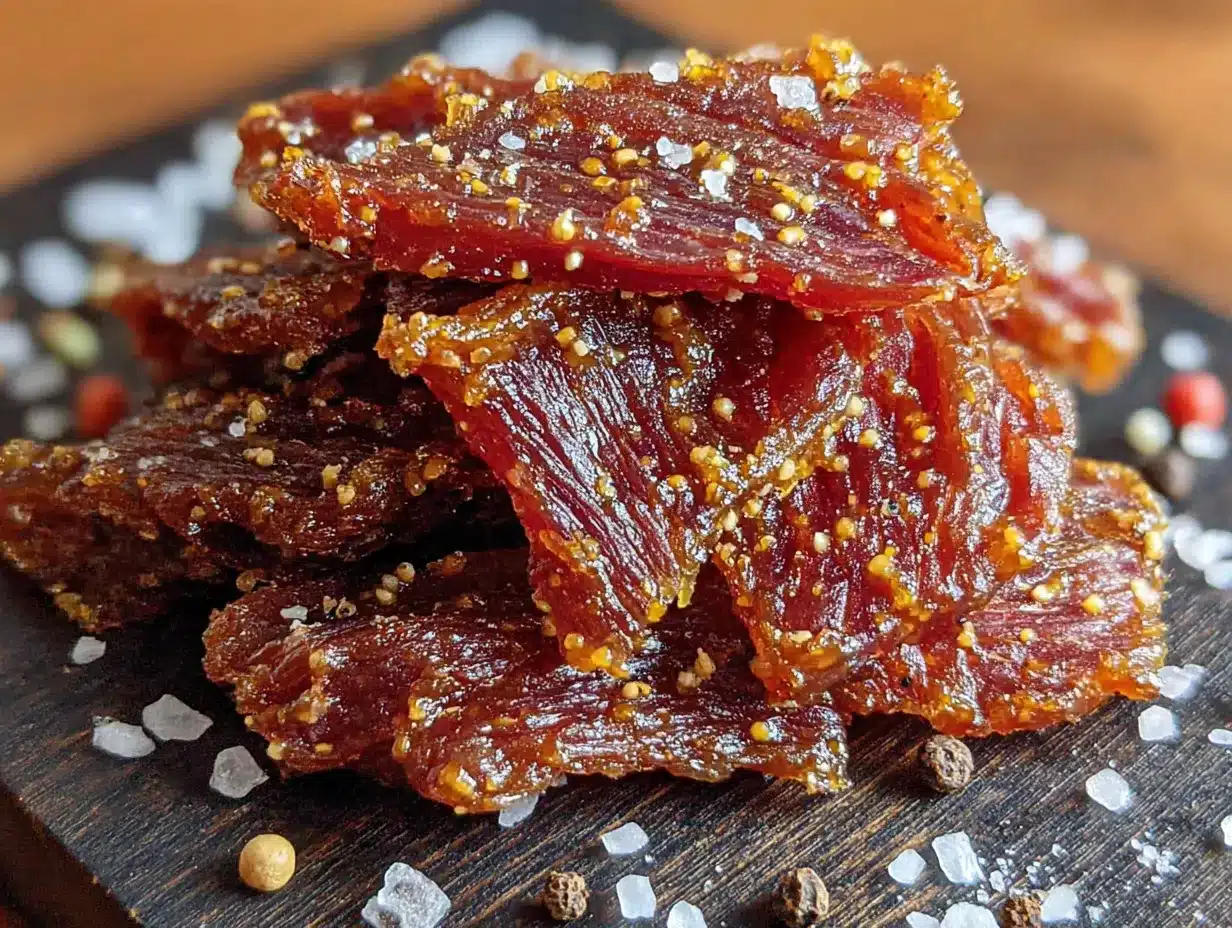
For the venison, look for cuts like top round, bottom round, or sirloin tip. These are lean, affordable cuts that slice beautifully for jerky. If you’re using a different game meat like elk or moose, this same marinade works perfectly—just adjust cooking time based on thickness.
The brown sugar is key here. It’s not just for sweetness—it helps create that slightly tacky, glossy surface on the finished jerky that everyone loves. And the black pepper? Don’t be shy. Coarse grind gives you those little pops of heat that make each bite interesting.
If you don’t have Worcestershire sauce, you can substitute with a mix of 2 tablespoons apple cider vinegar and 2 tablespoons fish sauce. It’s not exactly the same, but it gets you close. And if you’re out of soy sauce, coconut aminos work great for a slightly different flavor profile.
Equipment Needed
You don’t need a lot of fancy gear for this recipe, which is part of what makes it so budget-friendly. Here’s what you’ll need:
- Smoker: Any kind works—electric, charcoal, or pellet. I use a basic Masterbuilt electric smoker that I found on sale for under $150, and it’s been going strong for five years. If you don’t have a smoker, you can use a dehydrator or your oven on the lowest setting with the door cracked open.
- Sharp Knife: A good chef’s knife or slicing knife makes cutting thin, even strips so much easier. A dull knife will fight you the whole way and give you uneven pieces that cook at different rates.
- Cutting Board: A large, sturdy board with a groove to catch juices is ideal. I use a bamboo board that’s held up well.
- Mixing Bowls: One medium bowl for the marinade and one large bowl or zip-top bag for marinating the meat.
- Zip-Top Bags or Glass Dish: For marinating. I prefer gallon-sized zip-top bags because they take up less space in the fridge and make cleanup easy.
- Smoker Racks or Dehydrator Trays: Make sure they’re clean and lightly oiled or sprayed with nonstick spray to prevent sticking.
- Instant-Read Thermometer: Not strictly necessary for jerky, but helpful if you’re new to smoking and want to monitor temperatures.
- Paper Towels: For patting the meat dry before slicing and for cleaning up inevitable drips.
If you’re using a dehydrator, just set it to 160°F and let it run until the jerky bends and cracks but doesn’t snap. The process is similar, just without the smoke flavor. You can add liquid smoke to the marinade if you want that smoky taste without the smoker.
Preparation Method
This is the part where the magic happens. Take your time, and don’t rush the process—good jerky is a labor of love, but it’s a simple labor.
- Trim the Meat (15 minutes): Start with your venison, which should be partially frozen—this makes slicing so much easier. Using a sharp knife, trim away any silver skin, connective tissue, and visible fat. Fat is the enemy of jerky; it goes rancid and spoils the texture. Take your time here. I once rushed this step and ended up with a batch that tasted off after a week. Never again.
- Slice Against the Grain (20 minutes): Slice the meat into strips about 1/4-inch thick. Cutting against the grain gives you jerky that’s easier to chew. If you slice with the grain, you’ll get tougher, stringier jerky—which some people prefer, so it’s up to you. I like a mix: most strips against the grain, a few with the grain for variety. Aim for strips that are roughly 1 to 2 inches wide and 4 to 6 inches long.
- Make the Marinade (5 minutes): In a medium bowl, whisk together the soy sauce, Worcestershire sauce, brown sugar, black pepper, kosher salt, garlic powder, onion powder, curing salt (if using), and cold water. Whisk until the brown sugar is mostly dissolved. Taste it—it should be salty, sweet, and peppery. Adjust the pepper if you want more heat.
- Marinate the Meat (8 to 24 hours): Place the venison strips in a large zip-top bag or glass dish. Pour the marinade over the meat, seal the bag (squeezing out as much air as possible), and massage it gently to coat every strip. Refrigerate for at least 8 hours, but 12 to 24 is better. I usually start this the night before and let it go overnight. The longer it marinates, the deeper the flavor.
- Prepare the Smoker (15 minutes): About an hour before you’re ready to cook, preheat your smoker to 180°F to 200°F. I use hickory or applewood chips for this recipe—hickory gives a strong, classic smoky flavor, while applewood is milder and slightly sweet. Cherry wood is also fantastic. If you’re using an electric smoker, fill the chip tray and let it start producing smoke.
- Pat and Arrange the Strips (10 minutes): Remove the meat from the marinade and let the excess drip off. Pat each strip dry with paper towels—this helps the smoke adhere better and prevents a soggy texture. Lay the strips in a single layer on your smoker racks, making sure they don’t touch or overlap. Leave a little space between each piece for air circulation.
- Smoke the Jerky (3 to 5 hours): Place the racks in the preheated smoker and close the door. Smoke at 180°F to 200°F for 3 to 5 hours, depending on thickness and your desired texture. Start checking at the 3-hour mark. The jerky is done when it bends and cracks but doesn’t break in half. It should feel dry to the touch but still have a little give. If it snaps cleanly, it’s overdone.
- Cool and Rest (30 minutes): Remove the jerky from the smoker and let it cool completely on the racks. Don’t skip this step—the jerky continues to dry as it cools, and you want it to reach the perfect texture. Once cool, transfer to a clean bowl or paper towel-lined tray to absorb any residual moisture.
- Test a Piece (2 minutes): This is my favorite step. Pick a piece that looks representative—not the thinnest, not the thickest—and give it a taste. If it’s too moist, pop it back in the smoker for another 30 minutes. If it’s too dry, well, you’ve got a crunchy snack. Better to err on the side of slightly underdone; it will continue to dry as it sits.
- Store Properly (5 minutes): Once the jerky is completely cool, store it in an airtight container or zip-top bag. I use glass jars with tight-fitting lids. Keep it in a cool, dark place for up to 2 weeks, or refrigerate for up to a month. For longer storage, vacuum-seal and freeze—it’ll keep for 6 months or more.
Cooking Tips & Techniques
I’ve made a lot of mistakes with jerky over the years, so you don’t have to. Here are the things I wish someone had told me when I started.
Don’t skip the partial freeze. Trying to slice room-temperature venison is a nightmare. The meat squishes, the slices are uneven, and you end up with a mangled mess. Pop it in the freezer for 30 to 45 minutes until it’s firm but not frozen solid. It’ll slice like butter.
Watch your smoker temperature. I once got distracted and let my smoker creep up to 250°F. The jerky cooked too fast on the outside and was still raw in the middle. Keep it steady between 180°F and 200°F. If your smoker runs hot, crack the door slightly to let some heat escape.
Rotate the racks halfway through. Most smokers have hot spots. About 2 hours in, swap the racks top to bottom and front to back. This ensures even drying and prevents some pieces from getting overdone while others are still wet.
Test for doneness the right way. The “bend test” is your best friend. Take a piece off the smoker, let it cool for a minute, then bend it. If it bends and the surface cracks but doesn’t break, it’s perfect. If it snaps, it’s overdone. If it just bends without cracking, it needs more time.
Let it rest before storing. I know you’re excited, but don’t bag it up while it’s still warm. The residual heat creates steam, which turns your jerky soggy. Let it cool completely on the racks—at least 30 minutes—before packing it away.
One mistake I still make: I always think I need more smoke than I do. A thin, steady stream of smoke is all you need. Thick, billowing clouds can make the jerky bitter. Less is more, especially with milder woods like apple or cherry.
Variations & Adaptations
This recipe is a great base, but don’t be afraid to make it your own. Here are some variations I’ve tried and loved.
- Spicy Version: Add 1 to 2 tablespoons of red pepper flakes or a teaspoon of cayenne pepper to the marinade. You can also add sliced jalapeños or a splash of hot sauce. I did this for a Super Bowl party and it was gone in 20 minutes.
- Teriyaki Twist: Replace the soy sauce with teriyaki sauce and add a tablespoon of grated fresh ginger and a minced garlic clove. This gives the jerky a sweeter, more Asian-inspired flavor that’s incredible with pineapple chunks on the side.
- Maple Pepper: Swap the brown sugar for pure maple syrup (use 1/3 cup, as it’s thinner). The maple flavor pairs beautifully with the smoke, and the pepper cuts through the sweetness. This is my go-to for fall camping trips.
- Low-Sodium Option: Use low-sodium soy sauce and reduce the salt to 1 teaspoon. Add a splash of apple cider vinegar for acidity. It’s still flavorful but much gentler on the blood pressure.
- Dehydrator Method: No smoker? No problem. Follow the same marinating and slicing steps, then arrange the strips on dehydrator trays. Dehydrate at 160°F for 4 to 6 hours, checking periodically. Add 1 to 2 teaspoons of liquid smoke to the marinade to mimic the smoky flavor.
I once tried a version with coffee and cocoa powder mixed into the marinade. It was interesting—deep, rich, almost like a mole sauce—but it wasn’t for everyone. My brother-in-law loved it; my kids thought it was weird. The brown sugar and black pepper version is the one that gets requested over and over.
Serving & Storage Suggestions
This jerky is incredibly versatile. Here’s how to make the most of it.
Serving Temperature: Smoked deer jerky is best at room temperature. Take it out of the fridge or pantry about 15 minutes before you plan to serve it. It softens slightly and the flavors open up. I love it with a cold beer or a glass of iced tea.
Presentation: For a snack board, arrange the jerky on a wooden platter with cheese cubes, crackers, dried fruit, and nuts. It’s also fantastic crumbled over salads or stirred into baked beans for a smoky, meaty boost. My kids eat it straight out of the jar as an after-school snack—no complaints there.
Complementary Dishes: This jerky pairs beautifully with sharp cheddar cheese, apple slices, and a handful of almonds. For a heartier meal, serve it alongside a bowl of chili or a baked potato. It’s also a staple in my camping cooler—no refrigeration needed, and it’s perfect for hiking snacks.
Storage Instructions: Store in an airtight container in a cool, dark place for up to 2 weeks. In the refrigerator, it’ll last a month. For long-term storage, vacuum-seal and freeze for up to 6 months. The flavor actually improves after a week or so—the spices meld together and the texture evens out.
Reheating: You don’t really need to reheat jerky, but if you want to revive it after freezing, lay it on a baking sheet in a 200°F oven for 5 to 10 minutes. Let it cool completely before eating. The flavors develop over time, so don’t be surprised if it tastes even better a few days after you make it.
Nutritional Information & Benefits
This jerky is packed with protein and low in fat, making it a smart snack for active families. Here’s a rough estimate per serving (about 2 ounces):
- Calories: 180
- Protein: 26g
- Fat: 3g
- Carbohydrates: 8g
- Sugar: 6g
- Sodium: 600mg (varies based on soy sauce and salt)
Health Benefits: Venison is leaner than beef and rich in iron, zinc, and B vitamins. It’s a great source of high-quality protein that keeps you full and energized. The black pepper adds a touch of antioxidants, and the garlic powder supports immune health. If you skip the curing salt, the sodium content drops significantly.
Dietary Considerations: This recipe is naturally gluten-free if you use tamari instead of soy sauce. It’s also dairy-free, egg-free, and low-carb. The sugar content comes from the brown sugar, so if you’re watching your carbs, you can reduce it to 2 tablespoons or use a sugar substitute like Swerve Brown.
Potential Allergens: Soy (from soy sauce), and possibly gluten depending on your Worcestershire sauce and soy sauce. Always check labels if you’re cooking for someone with allergies.
Conclusion
This budget-friendly smoked deer jerky with brown sugar and black pepper is more than just a snack—it’s a way to turn a freezer full of venison into something your whole family will fight over. It’s affordable, simple, and absolutely delicious. I’ve made it for hunting camp, road trips, and lazy Sunday afternoons, and it never disappoints.
I love this recipe because it reminds me of that afternoon at Mark’s house, standing on his deck with a warm piece of jerky in my hand, realizing that the best things in life are often the simplest. You don’t need fancy equipment or exotic ingredients—just good meat, a little patience, and a willingness to try.
Give it a shot. Play with the seasonings, adjust the pepper to your liking, and make it your own. And when you do, come back and tell me how it turned out. I’d love to hear about your variations, your successes, and even your happy accidents. Drop a comment below, share a photo, or tag me on social media. Happy smoking, friends!
Frequently Asked Questions
Can I use beef instead of venison?
Absolutely. This recipe works beautifully with beef—look for lean cuts like top round, bottom round, or flank steak. The cooking time will be similar, though beef may take slightly longer depending on thickness.
Do I have to use curing salt?
No, but it’s recommended if you plan to store the jerky at room temperature for more than a week. Curing salt (Prague Powder #1) helps prevent bacterial growth and preserves that nice pink color. If you’re freezing or refrigerating, you can skip it.
How do I know when the jerky is done?
Use the bend test. Take a piece off the smoker, let it cool for a minute, then bend it. If it bends and cracks on the surface but doesn’t break in half, it’s done. If it snaps, it’s overdone. If it just bends without cracking, it needs more time.
Can I make this in the oven?
Yes! Preheat your oven to the lowest setting (usually 170°F to 200°F). Place the marinated strips on wire racks set over baking sheets. Prop the oven door open slightly with a wooden spoon to let moisture escape. Bake for 3 to 5 hours, checking periodically. Add liquid smoke to the marinade for that smoky flavor.
How long does homemade jerky last?
Stored properly in an airtight container, this jerky will last 2 weeks at room temperature, 1 month in the refrigerator, and up to 6 months in the freezer. Vacuum-sealing extends the freezer life even longer. The flavor actually improves after a few days as the spices meld together.
Pin This Recipe!
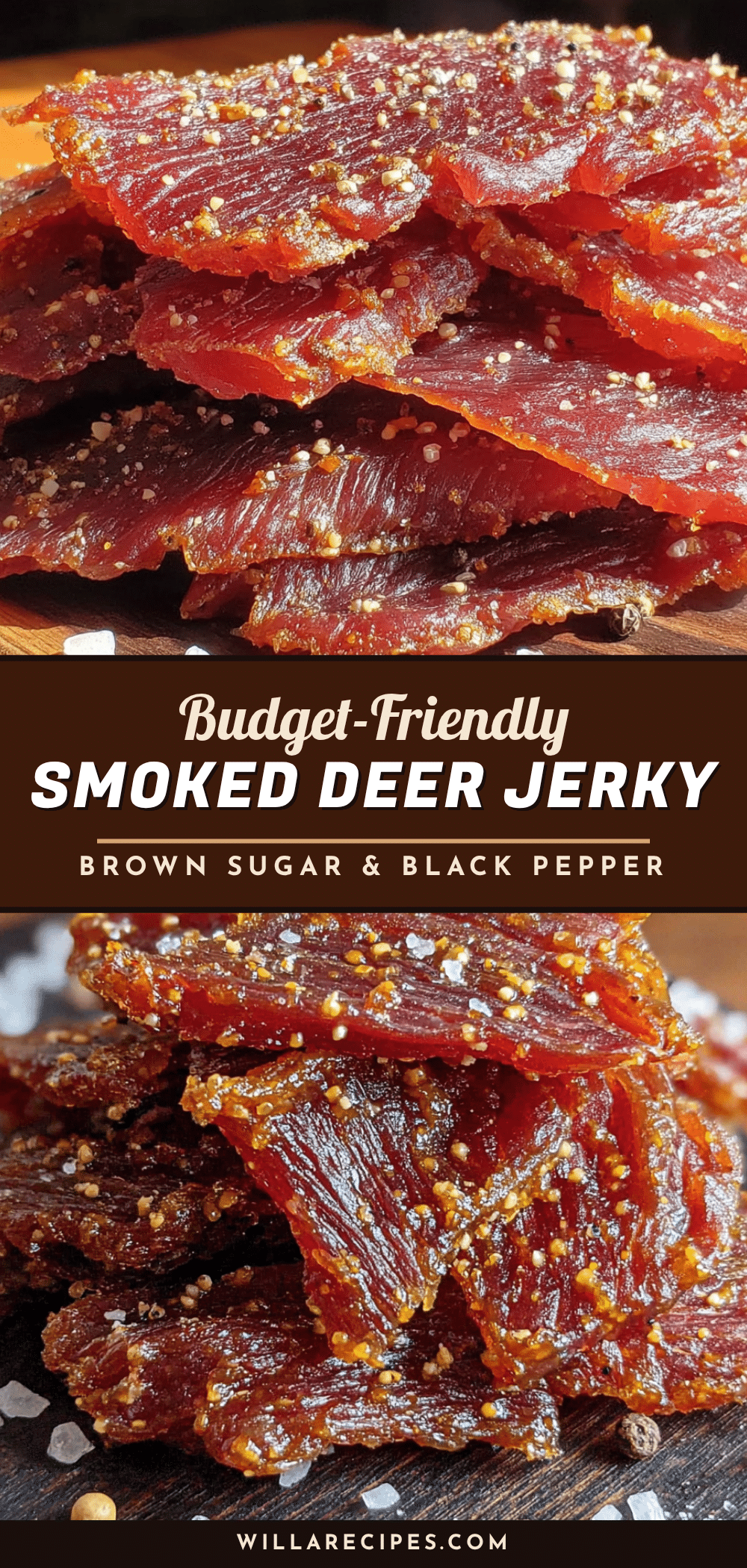
Best Easy Smoked Deer Jerky Budget Brown Sugar Black Pepper Recipe
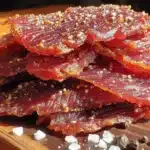
This budget-friendly smoked deer jerky with brown sugar and black pepper is a simple, delicious snack that turns a freezer full of venison into a crowd-pleasing treat. Made with affordable cuts and pantry staples, it’s perfect for lunches, road trips, and hunting season.
- Prep Time: 8 hours 30 minutes
- Cook Time: 3 hours
- Total Time: 11 hours 30 minutes
- Yield: 8 servings 1x
- Category: Snack
- Cuisine: American
Ingredients
- 2 pounds venison roast or steak (trimmed of all silver skin and excess fat)
- 1/2 cup low-sodium soy sauce
- 1/4 cup Worcestershire sauce
- 1/4 cup packed brown sugar (light or dark)
- 2 tablespoons coarsely ground black pepper
- 1 tablespoon kosher salt
- 1 teaspoon garlic powder
- 1 teaspoon onion powder
- 1/2 teaspoon curing salt (Prague Powder #1) (optional)
- 1/4 cup cold water
Instructions
- Trim the Meat (15 minutes): Start with your venison, which should be partially frozen. Using a sharp knife, trim away any silver skin, connective tissue, and visible fat.
- Slice Against the Grain (20 minutes): Slice the meat into strips about 1/4-inch thick. Cutting against the grain gives you jerky that’s easier to chew. Aim for strips that are roughly 1 to 2 inches wide and 4 to 6 inches long.
- Make the Marinade (5 minutes): In a medium bowl, whisk together the soy sauce, Worcestershire sauce, brown sugar, black pepper, kosher salt, garlic powder, onion powder, curing salt (if using), and cold water. Whisk until the brown sugar is mostly dissolved.
- Marinate the Meat (8 to 24 hours): Place the venison strips in a large zip-top bag or glass dish. Pour the marinade over the meat, seal the bag (squeezing out as much air as possible), and massage it gently to coat every strip. Refrigerate for at least 8 hours, but 12 to 24 is better.
- Prepare the Smoker (15 minutes): About an hour before you’re ready to cook, preheat your smoker to 180°F to 200°F. Use hickory or applewood chips.
- Pat and Arrange the Strips (10 minutes): Remove the meat from the marinade and let the excess drip off. Pat each strip dry with paper towels. Lay the strips in a single layer on your smoker racks, making sure they don’t touch or overlap.
- Smoke the Jerky (3 to 5 hours): Place the racks in the preheated smoker and close the door. Smoke at 180°F to 200°F for 3 to 5 hours, depending on thickness and your desired texture. Start checking at the 3-hour mark. The jerky is done when it bends and cracks but doesn’t break in half.
- Cool and Rest (30 minutes): Remove the jerky from the smoker and let it cool completely on the racks. Once cool, transfer to a clean bowl or paper towel-lined tray to absorb any residual moisture.
- Test a Piece (2 minutes): Pick a piece that looks representative and give it a taste. If it’s too moist, pop it back in the smoker for another 30 minutes.
- Store Properly (5 minutes): Once the jerky is completely cool, store it in an airtight container or zip-top bag. Keep it in a cool, dark place for up to 2 weeks, or refrigerate for up to a month. For longer storage, vacuum-seal and freeze.
Notes
For best results, partially freeze the venison before slicing. Rotate smoker racks halfway through cooking for even drying. The jerky continues to dry as it cools, so don’t over-smoke. If using a dehydrator, set to 160°F and add liquid smoke to the marinade. Store in an airtight container; flavor improves after a few days.
Nutrition
- Serving Size: 2 ounces
- Calories: 180
- Sugar: 6
- Sodium: 600
- Fat: 3
- Saturated Fat: 1
- Carbohydrates: 8
- Fiber: 1
- Protein: 26
Keywords: smoked deer jerky, venison jerky, brown sugar black pepper jerky, budget jerky, homemade jerky, deer jerky recipe