I was standing in the frozen foods aisle last November, staring at a cardboard box of stuffing mix, when the smell hit me. Not from the box—no, this was a memory, sharp and sudden. I was seven years old, standing on a step stool in my Aunt Carol’s tiny kitchen, watching her melt a whole stick of butter in a cast iron skillet. The scent of sage and onion and something deeply savory filled the air, and she was singing along to a Christmas album on the radio, completely off-key. She passed away three years ago, and I haven’t had her stuffing since. That day in the grocery store, I knew I had to figure it out myself. I mean, I’ve made stuffing before, plenty of times, but never hers. Never that specific, almost magical version that everyone fought over at the table.
So I bought four loaves of bread, three pounds of sausage, and more butter than I’m willing to admit. Let me tell you, the first attempt was a disaster—way too soggy, like a savory bread pudding that forgot to be proud of itself. But I kept at it. I called my cousin, I dug through old recipe cards, and I finally cracked the code. The secret, honestly, is the herb butter. It’s not just melted butter you pour in; it’s a whole compound butter situation that gets absorbed into every single crumb. That, and the sausage. You need a good, fatty sausage that releases its flavor into the bread as it bakes.
Maybe you’ve been there, standing in a store, trying to buy a shortcut for a dish that means too much. Maybe you’ve got a recipe from someone you miss. This Ultimate Herb Butter Sausage Stuffing is my way of holding onto a memory, and I’m pretty sure it’s the best version I’ve ever made. It’s the one that finally made me close my eyes and smile, just like I used to.
Why You’ll Love This Recipe
This isn’t just another stuffing recipe that shows up on Pinterest and disappears. This is the one that will get you texts the next day asking for the recipe. I’ve tested it six times across three different holidays, and it’s never let me down. Here’s why it’s a winner for your next gathering:
- Quick & Easy: Comes together in under an hour, with only 20 minutes of active prep. Perfect for when you’re juggling a turkey and a dozen other sides.
- Simple Ingredients: Nothing fancy here. Bread, sausage, butter, herbs, onion, celery—stuff you probably already have on your shopping list.
- Perfect for Hosting: This dish scales beautifully. Double it for a big crowd, or halve it for a cozy Friendsgiving. It holds up well in the oven while you finish the main course.
- Crowd-Pleaser: I’ve served this to picky eaters, serious foodies, and my uncle who “doesn’t like stuffing.” Every single plate came back clean.
- Unbelievably Delicious: The herb butter seeps into every nook and cranny of the bread, while the sausage adds a savory, meaty punch. The top gets perfectly crispy, and the inside stays tender and moist. It’s next-level comfort food.
What makes this different from every other stuffing recipe out there? It’s the technique. Most recipes just toss melted butter over bread cubes. Here, you create a compound herb butter—whipping softened butter with fresh herbs, garlic, and a pinch of salt—and then you toss it with the bread before baking. This ensures every single cube gets coated in flavor, not just the ones on top. Plus, the sausage is browned first, which renders out fat that gets soaked up by the bread. Trust me, this small extra step changes everything.
This recipe is the kind that makes you close your eyes after the first bite. It’s comfort food reimagined—richer, more aromatic, but with the same soul-soothing satisfaction of the stuffing you grew up with. Perfect for impressing your guests without stress, or turning a simple holiday meal into something truly memorable.
What Ingredients You Will Need
This recipe uses simple, wholesome ingredients to deliver bold flavor and satisfying texture without the fuss. Most of these are pantry staples or easy to find at any grocery store. I’ve tested a few different brands, and I’ve got some notes to help you pick the best ones.
- 1 lb (450g) good-quality pork sausage – I prefer a breakfast-style sage sausage, but Italian sausage (removed from casings) works beautifully too. Look for a brand with a high fat content—lean sausage will make the stuffing dry. (Jimmy Dean or a local butcher’s bulk sausage are my go-tos.)
- 1 cup (2 sticks / 226g) unsalted butter, softened – This is the star of the show. Use good butter here; it makes a difference. Let it sit out for an hour to soften properly.
- 1 large yellow onion, diced (about 2 cups) – Yellow onion gives the best savory base. You can use white onion in a pinch, but avoid red—it’s too sharp.
- 3 ribs celery, diced (about 1 cup) – Celery adds that classic crunch and freshness. Don’t skip it, even if you’re not a celery fan—it melts into the background.
- 1 loaf (about 1 lb / 450g) sturdy bread, cut into 1-inch cubes – A French baguette or sourdough loaf works best. Day-old bread is ideal, but you can dry fresh bread cubes in a 300°F oven for 10 minutes. Avoid soft sandwich bread—it turns to mush.
- 1/2 cup (15g) fresh parsley, finely chopped – Flat-leaf or curly both work. Parsley adds a fresh pop of color and a clean finish.
- 2 tablespoons fresh sage, finely chopped – Sage is non-negotiable here. Dried sage can be substituted (use 2 teaspoons), but fresh is so much better.
- 1 tablespoon fresh rosemary, finely chopped – Rosemary adds a piney, aromatic note. Strip the leaves off the woody stem before chopping.
- 1 tablespoon fresh thyme leaves – Thyme is subtle but essential. Run your fingers down the stem to strip the leaves easily.
- 4 cloves garlic, minced – Fresh garlic is best. Pre-minced jarred garlic will work, but use 2 teaspoons and expect a milder flavor.
- 1 1/2 cups (360ml) low-sodium chicken broth – Low-sodium is key so you can control the salt level. Vegetable broth works for a vegetarian version.
- 2 large eggs, lightly beaten – Eggs help bind the stuffing together. Without them, it can be crumbly.
- Salt and freshly ground black pepper, to taste – Go easy on the salt since the sausage and butter are already salted. I usually start with 1/2 teaspoon and adjust.
Ingredient Substitutions: For a gluten-free version, use a good quality gluten-free bread. For a dairy-free option, substitute the butter with a high-quality vegan butter (Miyoko’s is my favorite) and use a dairy-free sausage. If you can’t find fresh herbs, dried herbs work—just use one-third of the amount.
Equipment Needed
You don’t need a fancy kitchen to pull this off. Here’s what you’ll need:
- Large skillet or sauté pan – For browning the sausage and cooking the vegetables. A 12-inch pan is ideal.
- 9×13-inch baking dish – This is the standard size for a full batch. A 3-quart casserole dish works too.
- Large mixing bowl – Big enough to toss the bread cubes with the butter and other ingredients without spilling.
- Chef’s knife and cutting board – For dicing the onion, celery, and herbs.
- Wooden spoon or spatula – For stirring and tossing.
- Measuring cups and spoons – Accuracy matters, especially with the broth.
- Whisk – For beating the eggs.
- Aluminum foil – To cover the dish during the first part of baking.
If you don’t have a 9×13 dish, you can use two 8×8 pans or even a cast iron skillet. Just adjust the baking time slightly—smaller pans might cook faster. I’ve used a disposable aluminum pan before when bringing this to a potluck, and it worked perfectly.
Preparation Method
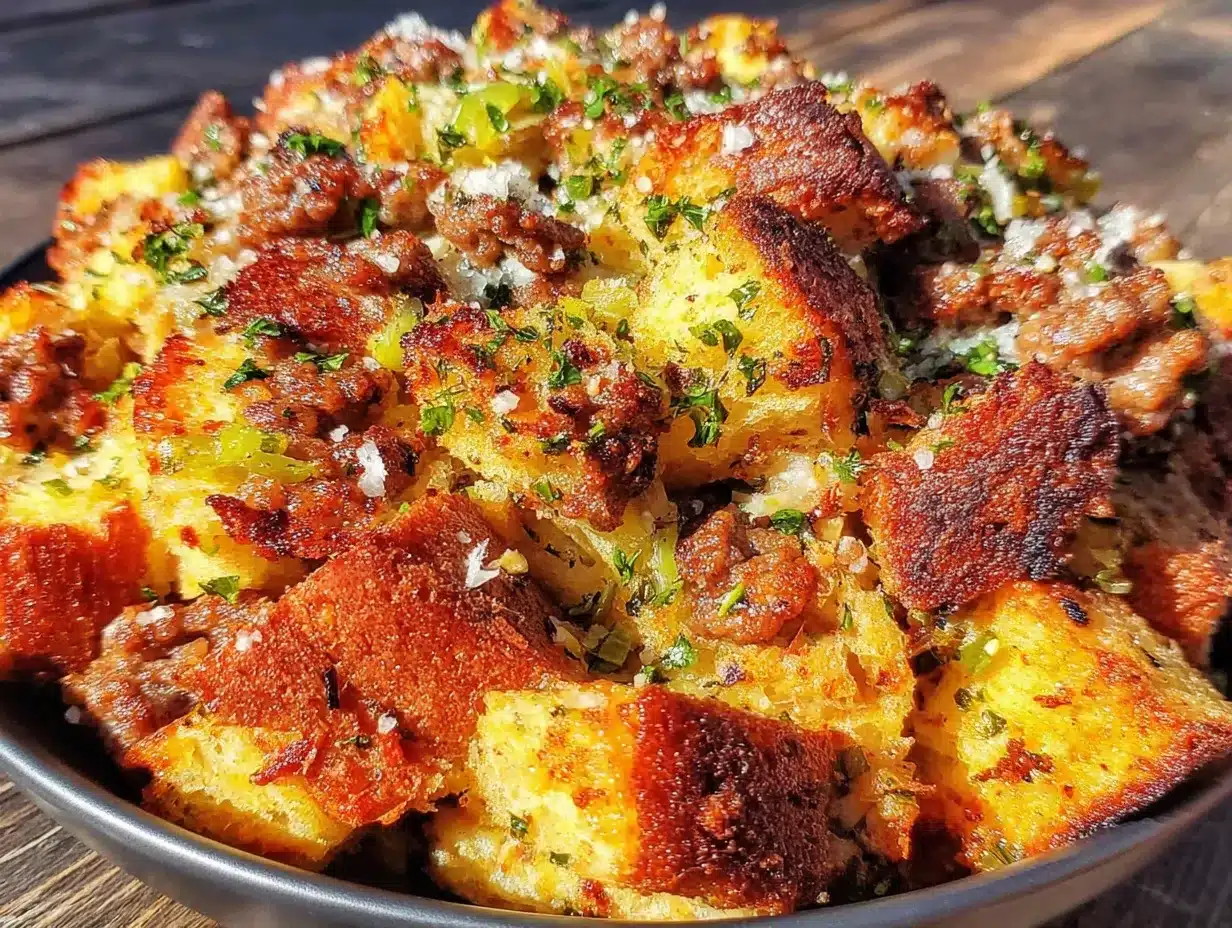
Let’s get cooking. This recipe comes together in a few simple stages, and I’ll walk you through each one. The total time is about 1 hour, with only 20 minutes of active work.
- Preheat your oven to 375°F (190°C). Position a rack in the middle of the oven. While it heats, spread your bread cubes on a baking sheet in a single layer. Toast them for 8-10 minutes, until they’re dry and just starting to turn golden. (This step is crucial—wet bread turns into a soggy mess.) Set them aside to cool.
- Make the herb butter. In a small bowl, combine the softened butter, minced garlic, chopped parsley, sage, rosemary, and thyme. Add a pinch of salt and a few cracks of black pepper. Mash it all together with a fork until the herbs are evenly distributed. (I like to use my hands for this—it’s faster and you can feel if the butter is soft enough.) Set aside.
- Brown the sausage. Heat your large skillet over medium-high heat. Add the sausage and cook, breaking it apart with a wooden spoon, until it’s browned and cooked through—about 6-8 minutes. Use a slotted spoon to transfer the sausage to a plate, leaving the rendered fat in the pan. (Don’t drain it! That fat is liquid gold.)
- Sauté the aromatics. Reduce the heat to medium. Add the diced onion and celery to the same skillet with the sausage fat. Cook, stirring occasionally, for 5-6 minutes, until the onion is translucent and the celery is softened. Scrape up any browned bits from the bottom of the pan. Remove from heat and let cool slightly.
- Combine the base ingredients. In your large mixing bowl, combine the toasted bread cubes, cooked sausage, and sautéed vegetables. Add the herb butter in dollops. Use your hands or a large spatula to toss everything together, making sure the butter coats the bread cubes evenly. (This is the messy, satisfying part.)
- Add the liquid. In a small bowl or measuring cup, whisk together the chicken broth and beaten eggs. Pour this mixture over the bread mixture. Toss gently but thoroughly—you want every cube to be moistened, but not swimming. Let it sit for 5 minutes so the bread can absorb the liquid. (If it looks dry, add an extra 1/4 cup of broth.)
- Transfer to the baking dish. Lightly grease your 9×13-inch baking dish with butter or non-stick spray. Pour the stuffing mixture into the dish and spread it into an even layer. Don’t press it down too hard—you want some texture and air pockets for a nice crust.
- Bake covered. Cover the dish tightly with aluminum foil and bake for 25 minutes. This steams the stuffing and ensures the inside is perfectly moist.
- Bake uncovered. Remove the foil and bake for another 15-20 minutes, until the top is golden brown and crispy. The edges should be slightly crunchy, and the center should be set but still tender. (If you like it extra crispy, broil for 2-3 minutes at the end—watch it carefully so it doesn’t burn.)
- Rest and serve. Let the stuffing rest for 5-10 minutes before serving. This allows it to set up and makes it easier to scoop. Garnish with a little fresh parsley if you’re feeling fancy.
Sensory cues: At step 2, the herb butter should smell intensely aromatic, like a walk through a garden. At step 6, the bread should feel damp but not soggy—like a sponge that’s been wrung out. At step 9, the top should be deeply golden with crispy edges you can hear when you cut into it.
Cooking Tips & Techniques
I’ve made this recipe enough times to know where things can go wrong. Here’s what I’ve learned, often the hard way.
Don’t skip toasting the bread. I know, it’s an extra step, but fresh bread will turn into a gluey paste. Toasting dries it out so it can absorb the herb butter and broth without falling apart. One time I was in a rush and skipped it—the stuffing was edible, but it was more like a dense bread pudding. Not the look you want on a holiday table.
Use cold broth. This sounds weird, but warm broth can start cooking the eggs before the stuffing hits the oven, leading to a rubbery texture. I always pull my broth from the fridge right before mixing. Small detail, big difference.
Season in layers. Don’t just dump all the salt in at the end. Season the sausage as it browns, add a pinch to the vegetables, and season the herb butter. This builds depth of flavor that you can’t get from a single seasoning step.
Watch your liquid ratio. Different breads absorb liquid differently. A sturdy sourdough might need the full 1 1/2 cups of broth, while a softer French loaf might only need 1 1/4 cups. Start with less, and add more if the bread still looks dry after sitting for 5 minutes. You want it moist but not soupy.
Make it ahead. This stuffing is a lifesaver for hosting. You can assemble it the night before, cover it, and refrigerate. Just add 10-15 minutes to the baking time since you’re starting from cold. I’ve done this for three Thanksgivings now, and it’s never failed me.
Don’t overmix. When you add the broth and eggs, toss gently. Overmixing breaks down the bread cubes and gives you a mushy texture. You want distinct pieces of bread that hold their shape.
Variations & Adaptations
This recipe is a great base, but don’t be afraid to make it your own. Here are some variations I’ve tried and loved.
- Vegetarian Version: Swap the sausage for 8 oz of finely chopped mushrooms (cremini or shiitake work best) and an extra tablespoon of olive oil. Sauté them until they release their liquid and start browning. Add 1/2 teaspoon of smoked paprika for that savory depth. My vegetarian sister-in-law requests this version every year.
- Apple & Cranberry Stuffing: Add 1 cup of diced Granny Smith apple and 1/2 cup of dried cranberries to the bread mixture before adding the broth. The sweetness balances the savory herb butter beautifully. This is my go-to for a fall dinner party—it’s festive and unexpected.
- Gluten-Free Adaptation: Use a good quality gluten-free bread. I like Schär’s artisan loaf. Toast it a little longer than regular bread—gluten-free bread tends to be more moist and needs extra drying. Everything else stays the same.
- Spicy Sausage Twist: Use hot Italian sausage instead of breakfast sausage, and add 1/2 teaspoon of red pepper flakes to the herb butter. The heat cuts through the richness and keeps people coming back for more. I made this for a Friendsgiving, and it was the first dish to disappear.
- Herb Substitutions: Not a fan of rosemary? Swap it for 1 tablespoon of fresh tarragon or marjoram. Both add a lovely, slightly floral note. I tried tarragon once when I ran out of rosemary, and honestly, I might like it better now.
Serving & Storage Suggestions
This stuffing is a star on any holiday table, but it’s versatile enough for weeknight dinners too.
Serving: Serve it hot, straight from the oven. The contrast between the crispy top and the tender interior is the whole point. I like to transfer it to a warm serving platter and garnish with a sprinkle of fresh parsley and a few cracked black peppercorns. It pairs beautifully with roast turkey or chicken, but don’t sleep on serving it alongside a simple roasted pork loin or even a grilled steak. For a vegetarian meal, it’s great with a lentil loaf or stuffed portobello mushrooms.
What to serve alongside: A bright, acidic side like a cranberry relish or a simple green salad with vinaigrette cuts through the richness. Roasted Brussels sprouts or green bean casserole are classic companions. If you’re hosting a full spread, this stuffing holds its own next to mashed potatoes and gravy.
Storage: Leftover stuffing keeps in the refrigerator for up to 4 days. Store it in an airtight container. The flavors actually meld and deepen overnight—I often like it even better the next day.
Reheating: The best way to reheat is in the oven. Spread the stuffing in a baking dish, add a splash of chicken broth (about 1/4 cup per 2 cups of stuffing), cover with foil, and bake at 350°F for 15-20 minutes. Uncover for the last 5 minutes to re-crisp the top. The microwave works in a pinch, but the texture won’t be as good—it’ll be softer and less crispy.
Freezing: You can freeze this stuffing for up to 3 months. Assemble it completely but don’t bake it. Wrap the dish tightly in plastic wrap, then foil. To bake from frozen, remove the plastic, cover with foil, and bake at 350°F for 45-50 minutes. Uncover and bake for another 15-20 minutes until golden. I’ve done this for a pre-Christmas prep session, and it was a lifesaver.
Nutritional Information & Benefits
Let’s be real—this is a holiday dish, not a health food. But it’s made with real, whole ingredients, and there are some surprising benefits hidden in that buttery goodness.
Estimated per serving (1 cup, based on 12 servings):
- Calories: 385
- Fat: 22g
- Saturated Fat: 10g
- Carbohydrates: 32g
- Fiber: 2g
- Sugar: 4g
- Protein: 14g
- Sodium: 620mg
Health highlights: The fresh herbs (sage, rosemary, thyme, parsley) are packed with antioxidants and anti-inflammatory compounds. Sage has been shown to support brain health, and rosemary is rich in rosmarinic acid, which has anti-inflammatory properties. The celery provides a good dose of vitamin K and fiber. The eggs add high-quality protein. And yes, butter contains butyrate, a fatty acid that supports gut health—in moderation, of course.
Dietary considerations: This recipe contains gluten, dairy, and eggs. For gluten-free and dairy-free adaptations, see the variations section. It’s not suitable for a low-fat or low-calorie diet, but honestly, that’s not the point of this dish. It’s comfort food, meant to be enjoyed in good company.
Conclusion
This Ultimate Herb Butter Sausage Stuffing is more than just a side dish—it’s the recipe that brings people together. It’s the one that gets passed around the table with exclamations of “who made this?” and “I need the recipe.” It’s the dish that makes you feel like a hosting rockstar, even if you’re juggling a dozen other things.
I love this recipe because it honors the memory of my Aunt Carol while being completely my own. It’s the perfect blend of tradition and technique, and it never fails to make me smile. I hope you’ll make it your own, too. Add your favorite herbs, swap in different sausage, or throw in some dried fruit—this recipe is forgiving and adaptable.
I’d love to hear how it turns out for you. Drop a comment below and let me know if you tried any variations, or tag me in your photos on social media. Happy cooking, and here’s to making memories around the table!
Frequently Asked Questions
Can I make this stuffing ahead of time?
Yes, absolutely. You can assemble the entire dish the night before, cover it, and refrigerate. When you’re ready to bake, add about 10-15 minutes to the covered baking time since you’re starting from cold. This is my go-to strategy for Thanksgiving—it frees up oven space and reduces stress.
Can I use dried herbs instead of fresh?
You can, but the flavor won’t be as bright. If using dried herbs, use one-third of the amount called for fresh. So, for 2 tablespoons of fresh sage, use 2 teaspoons of dried. Rehydrate dried herbs in a tablespoon of warm water for 5 minutes before adding to the butter.
What’s the best bread for stuffing?
A sturdy, crusty bread like sourdough, French baguette, or ciabatta is ideal. Day-old bread is perfect because it’s already dried out. Avoid soft sandwich bread—it will turn into a gluey mess. If you only have fresh bread, cube it and toast it in a 300°F oven for 10 minutes.
How do I prevent my stuffing from being too dry or too soggy?
The key is the liquid-to-bread ratio. Start with 1 1/4 cups of broth, toss, and let it sit for 5 minutes. If the bread still feels dry, add more broth a tablespoon at a time. The stuffing should look moist but not wet, and there should be no standing liquid in the bowl. Also, make sure you toast the bread well—dry bread absorbs liquid evenly.
Can I double this recipe for a larger crowd?
Yes, this recipe doubles beautifully. Use a larger baking dish (a 12×17-inch roasting pan works well) or two 9×13-inch dishes. You may need to increase the baking time by 5-10 minutes. Just keep an eye on it and look for that golden, crispy top.
Pin This Recipe!
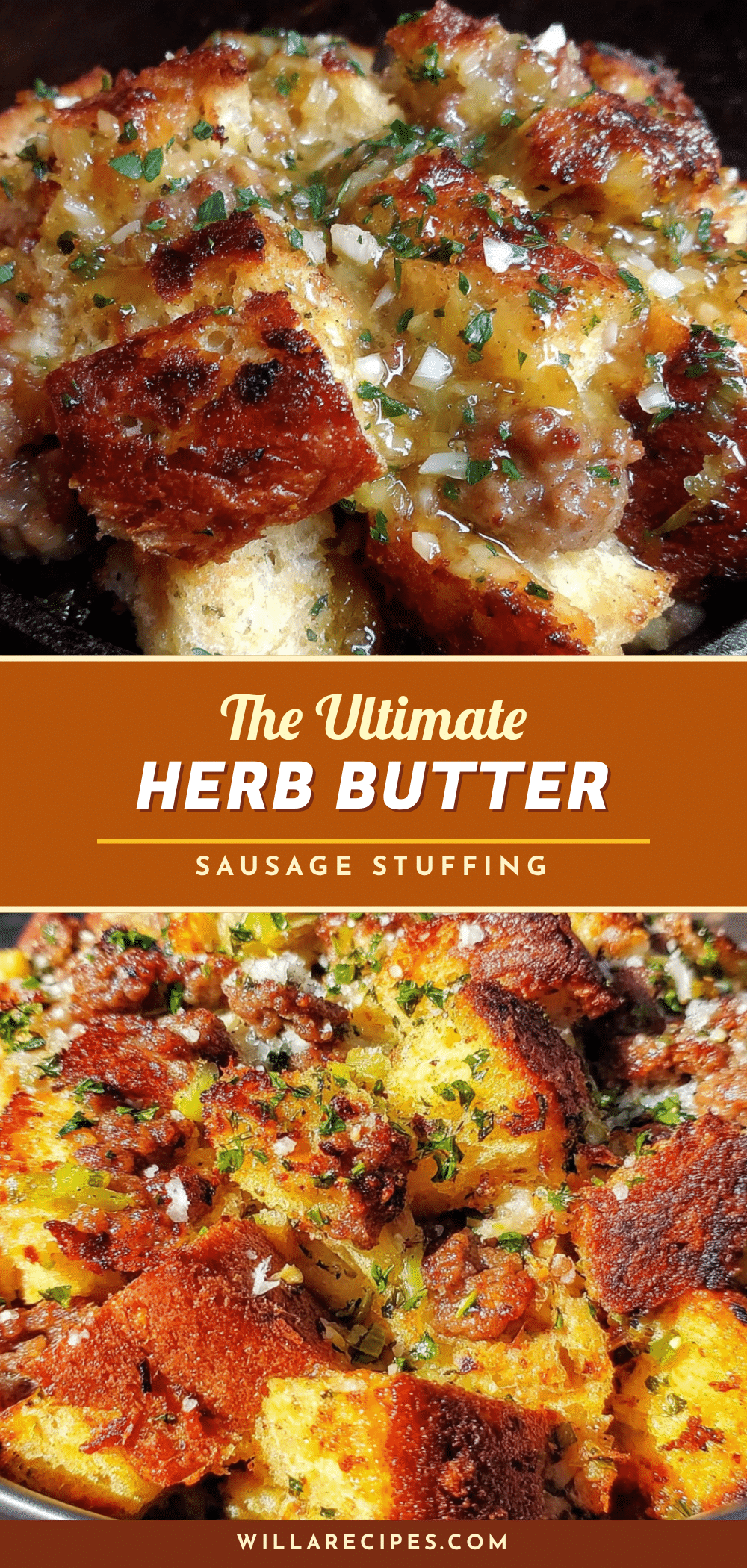
Ultimate Herb Butter Sausage Stuffing – Easy, Best Homemade Recipe

This Ultimate Herb Butter Sausage Stuffing is a rich, aromatic side dish featuring a compound herb butter that coats every bread cube, savory sausage, and a perfect crispy top. It’s a crowd-pleasing recipe that honors tradition while being completely your own.
- Prep Time: 20 minutes
- Cook Time: 40 minutes
- Total Time: 1 hour
- Yield: 12 servings 1x
- Category: Side Dish
- Cuisine: American
Ingredients
- 1 lb (450g) good-quality pork sausage (breakfast-style sage or Italian sausage)
- 1 cup (2 sticks / 226g) unsalted butter, softened
- 1 large yellow onion, diced (about 2 cups)
- 3 ribs celery, diced (about 1 cup)
- 1 loaf (about 1 lb / 450g) sturdy bread (French baguette or sourdough), cut into 1-inch cubes
- 1/2 cup (15g) fresh parsley, finely chopped
- 2 tablespoons fresh sage, finely chopped
- 1 tablespoon fresh rosemary, finely chopped
- 1 tablespoon fresh thyme leaves
- 4 cloves garlic, minced
- 1 1/2 cups (360ml) low-sodium chicken broth
- 2 large eggs, lightly beaten
- Salt and freshly ground black pepper, to taste
Instructions
- Preheat your oven to 375°F (190°C). Spread bread cubes on a baking sheet in a single layer and toast for 8-10 minutes until dry and just starting to turn golden. Set aside to cool.
- Make the herb butter: In a small bowl, combine softened butter, minced garlic, chopped parsley, sage, rosemary, and thyme. Add a pinch of salt and a few cracks of black pepper. Mash together until herbs are evenly distributed. Set aside.
- Brown the sausage: Heat a large skillet over medium-high heat. Add sausage and cook, breaking it apart, until browned and cooked through (6-8 minutes). Use a slotted spoon to transfer sausage to a plate, leaving rendered fat in the pan.
- Sauté the aromatics: Reduce heat to medium. Add diced onion and celery to the same skillet with sausage fat. Cook, stirring occasionally, for 5-6 minutes until onion is translucent and celery is softened. Scrape up browned bits from the pan. Remove from heat and let cool slightly.
- Combine base ingredients: In a large mixing bowl, combine toasted bread cubes, cooked sausage, and sautéed vegetables. Add herb butter in dollops. Toss everything together until butter coats the bread cubes evenly.
- Add the liquid: In a small bowl, whisk together chicken broth and beaten eggs. Pour over the bread mixture. Toss gently but thoroughly until every cube is moistened but not swimming. Let sit for 5 minutes so bread can absorb liquid. If it looks dry, add an extra 1/4 cup of broth.
- Transfer to baking dish: Lightly grease a 9×13-inch baking dish with butter or non-stick spray. Pour stuffing mixture into dish and spread into an even layer. Don’t press down too hard.
- Bake covered: Cover dish tightly with aluminum foil and bake for 25 minutes.
- Bake uncovered: Remove foil and bake for another 15-20 minutes until top is golden brown and crispy. For extra crispiness, broil for 2-3 minutes at the end, watching carefully.
- Rest and serve: Let stuffing rest for 5-10 minutes before serving. Garnish with fresh parsley if desired.
Notes
Don’t skip toasting the bread—fresh bread will turn into a gluey paste. Use cold broth to prevent the eggs from cooking prematurely. Season in layers for depth of flavor. Different breads absorb liquid differently; start with less broth and add more if needed. This stuffing can be assembled the night before and refrigerated; add 10-15 minutes to baking time. For a vegetarian version, swap sausage for 8 oz finely chopped mushrooms and an extra tablespoon of olive oil.
Nutrition
- Serving Size: 1 cup
- Calories: 385
- Sugar: 4
- Sodium: 620
- Fat: 22
- Saturated Fat: 10
- Carbohydrates: 32
- Fiber: 2
- Protein: 14
Keywords: stuffing, herb butter, sausage stuffing, Thanksgiving, holiday side dish, homemade stuffing, easy stuffing recipe